Sign in. It’s quick, free and it’s up to you.
An account is an optional way to support the work we do. Find out more.
Sign in. It’s quick, free and it’s up to you.
An account is an optional way to support the work we do. Find out more.

The FOI Files is a series from our team at The Journal Investigates. Each week, one of our investigative journalists brings you inside the fight for information that we’re all entitled to. They’ll share their documents, their stories – and tips on how to take the journey for yourself.
This week’s file is from investigative journalist Conor O’Carroll.
See here for The Journal Investigates’ most recent investigations.
SOMETIMES WHEN YOU have given up all hope of ever receiving a response to an FOI, it lands in your inbox.
This happened to me recently with a request I made to the Department of Justice on rules governing asylum seekers.
I mentioned this FOI in one of the early editions of this series, where I wrote about the Department of Justice’s tendency not to respond to requests on time.
This detailed how the Department took 56 working days to respond to one request, far beyond the standard 20 working day statutory limit.
But I also referenced the FOI where I sought records relating to the changes made to the rules governing asylum seekers, citizenship eligibility and family reunification.
Despite asking for an internal review, some eight months had passed since I originally sent it.
Then, just over three weeks after we referenced it in The FOI Files, the documents arrived.
Did someone from the Department read the article and my complaints, or is it just a coincidence with the FOI office working through the backlog? I guess we’ll never know.
But almost nine months, or 179 working days, after sending the request, I finally had a response.
So what does it say?
Among the records that were released was a briefing note (which you can read here) prepared for Minister for Justice Jim O’Callaghan on reviewing the policy of family reunification.
Changes to this policy were implemented in June this year, which made it harder for families to reunify in Ireland.
It included higher income thresholds for sponsors and a requirement to demonstrate proof that the joining family members can be accommodated.
The briefing we obtained provides insights into how officials reached the decision on making the changes.
The main reason for the policy review was that the previous legislation was “difficult to use and is unclear in places”, but officials at the Department of Justice also focused on another aspect, which they said “made the review more pressing”.
It was the discretion afforded to immigration officials to waive the requirements of the family reunification policy in exceptional humanitarian circumstances.
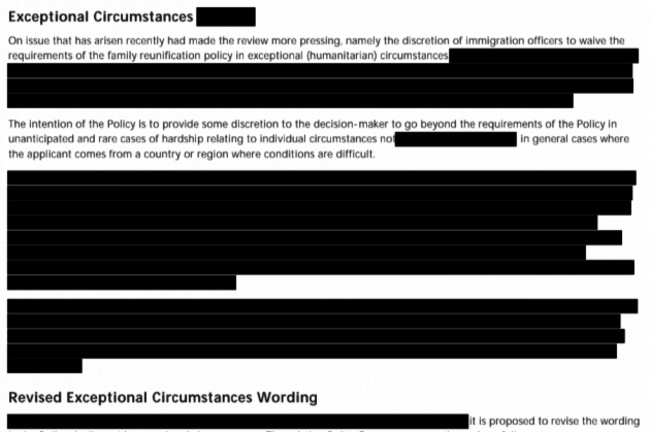
Much of what was discussed around this aspect has been redacted thanks to our old friend Section 29 of the Freedom of Information Act, which covers issues that are under ‘deliberation’ by an FOI body.
But we can still infer a good amount of information from what was left.
The intention behind having an exceptional circumstances waiver, the officials wrote, was so that a decision-maker could “go beyond the requirements of the policy in unanticipated and rare cases of hardship”.
But it appears from the way that briefing note was written that some immigration officials were interpreting the rules on exceptional humanitarian circumstances to include the general conditions of a country from which an applicant was coming.
This was not what was supposed to happen, the officials stated in the briefing note.
They said that to rely on exceptional circumstances, the hardship experienced must be “relating to individual circumstances not [redacted] in general cases where the applicant comes from a country or region where conditions are difficult”. They later added:
This wording was intended to apply to the particular circumstances of the individual concerned, as opposed to the general conditions in a country or region.
As part of the changes introduced, the policy document was amended “to return the policy to its original intention and to clarify where discretion does and does not exist”.
The decision to waive the normal qualifying criteria now rests with the minister, and it has been made clear that it must relate to the “specific exceptional circumstances of the sponsor/family member, as opposed to the generalised circumstances of the country in which the family member resides”.
The records shine a light on how the Department reached a decision on sweeping changes to Ireland’s immigration system.
In recent weeks, more changes have been announced on the pathway to citizenship and so, as you might expect, I’ve sent an FOI for similar records on that decision-making process.
I just hope that it arrives a lot quicker than this one.
You can read the full released FOI here.
If you have a burning FOI question about how to get certain records or why your request was refused, you can get in touch with our team at investigates@thejournal.ie. The Journal Investigates team will be back with another instalment of The FOI Files next Tuesday.

To embed this post, copy the code below on your site













have your say